Hover a labeled part of the illustration to trace it through the model.
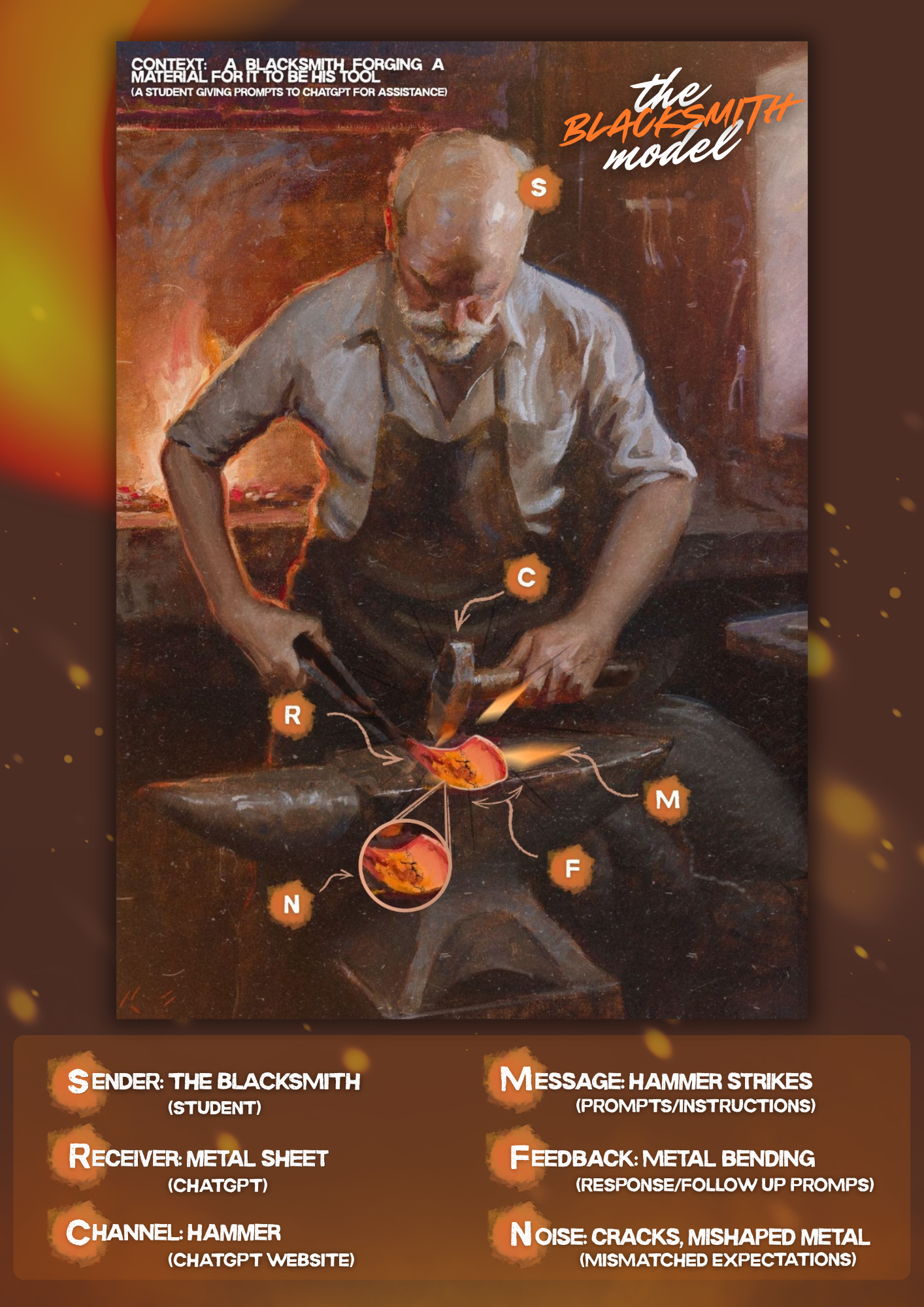
The Blacksmith Model illustrates the communication process between a student and ChatGPT while the student uses AI to create and refine academic material. The model may also be applied to other situations where a person relies on an AI system to develop, revise, or improve an output through repeated prompts and responses.
The Blacksmith Model focuses on six main elements: the blacksmith, metal sheet, hammer, metal bending, cracks and misshapen metal, and the resulting material. The blacksmith represents the student, who provides the prompts and instructions, while the metal sheet represents ChatGPT, which receives and processes the student's messages. The hammer strikes represent the student's prompts and instructions, which shape the direction of the interaction. The metal bending represents the feedback produced through ChatGPT's responses and the student's follow-up prompts, as each exchange influences the next. The resulting material represents the developing output of the interaction, such as the completed reviewer.
The model also represents the effects of emotional semantics and reliance throughout the process. As the blacksmith repeatedly strikes and shapes the metal, the interaction may become more forceful or frustrated when the material does not take the expected form, representing changes in the student's language toward ChatGPT. At the same time, continued shaping with the same tool represents increasing reliance on ChatGPT as the student increasingly consults and incorporates its responses. Finally, the cracks and misshapen metal represent communication barriers, such as ambiguous prompts, misunderstood instructions, inaccurate responses, or mismatched expectations, which may affect the resulting output.
Hover a labeled part of the illustration to trace it through the model.